
Kings County Court Records Path
After a Brooklyn arrest, the jail file and the court file serve different needs. NYPD arrest processing comes first. If the person is held for arraignment and then committed to local custody, the New York City Department of Correction may show current custody details in its Person in Custody Lookup. The court record begins with the formal criminal case. It can show arraignment, accusatory instruments, motions, adjourn dates, bail decisions, warrants, dispositions, sentences, and sealed-status limits.
The local court path is shaped by New York City's structure. New York City Criminal Court handles misdemeanors and lesser offenses, and it conducts arraignments and preliminary hearings for felonies. Felony cases may later move to Supreme Court after indictment or another felony filing. For custody and booking details, use Kings County jail inmate records. For booking-photo questions, use Kings County jail mugshots. Court records after arrest answer a narrower question: what charge record exists in court, and what is the case status now?
Find Kings County Court Records
A practical search starts with the identifier closest to the stage of the case. If the person is in DOC custody, the NYC DOC Person in Custody Lookup can show a book and case number, court date, court location, charges, bail or bond, NYSID, and holding location. If the docket prefix is KN, NYC311 identifies that as Kings County or Brooklyn. That helps route the court records after a jail arrest to the correct borough court channel.
- Check the DOC lookup first when the person may still be in city jail custody.
- Use the court date, court location, docket prefix, name, or case number shown in the custody record.
- Use New York eCourts or the Criminal Court channel for appearance dates and case status.
- Use the Kings County Clerk portal for public clerk case search options when the case type is filed with the clerk.
- Ask the clerk for official copies or older records that are not complete online.
- Use CHRS only when the need is a statewide New York criminal-history search.
New York Courts says a Criminal History Record Search, often called CHRS, costs $95. CHRS is not the same thing as a free custody lookup or a free docket check. It is a statewide court-run search product. For a single Brooklyn case, the court clerk, Criminal Court lookup path, and Kings County Clerk portal are often more direct than a statewide criminal-history request.
Kings County Clerk Controls
The Kings County Clerk case-search portal is useful because it shows the public entry points a searcher can use before requesting more detail. The visible controls include guest search and account options. Guest access is the first stop for public case, lien, and business records. Attorney and public account links can support deeper access where the portal allows it.
The Kings County Clerk search screen from the official portal shows the guest and account choices used to begin a clerk search.
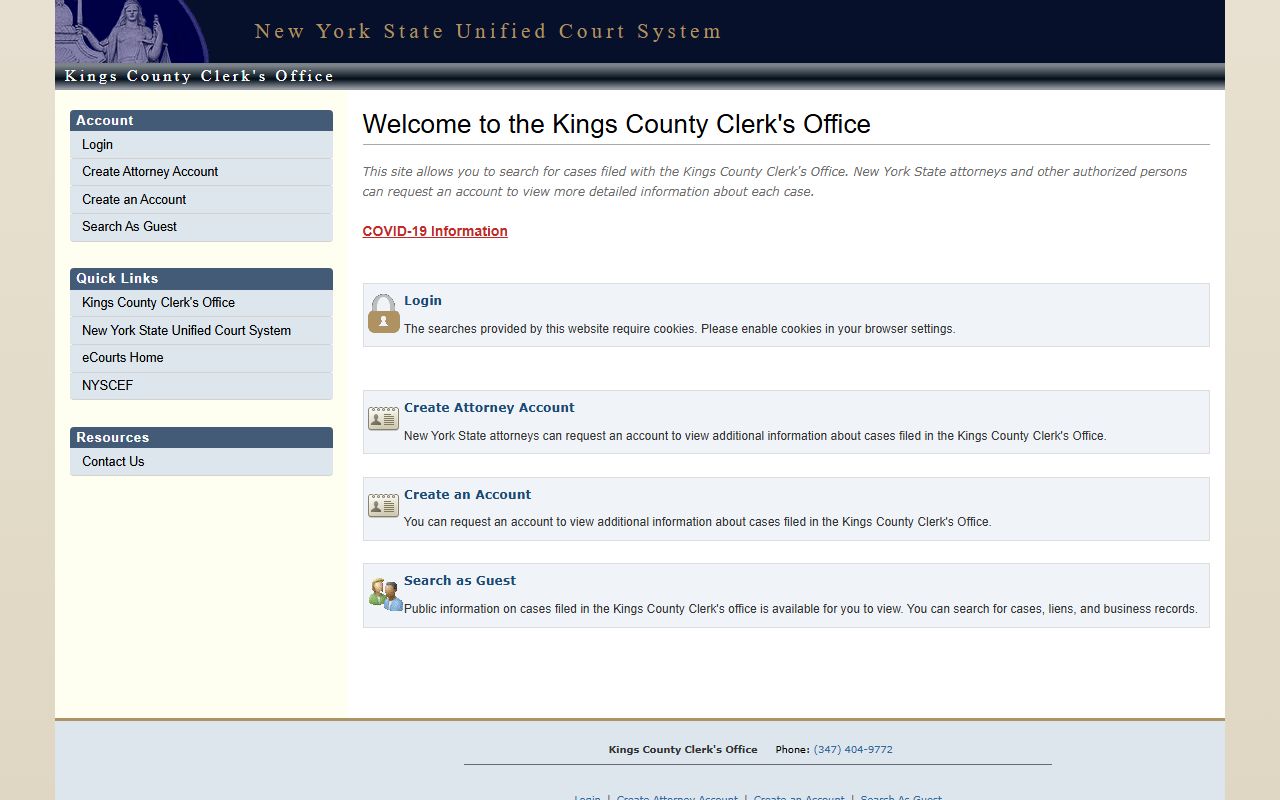
Use the portal as a routing point, not as a promise that every criminal filing will be visible in full. Courts separate public case records from administrative agency records. For court filings and dispositions, the clerk is the source. For jail custody records, use DOC. For arrest reports, use NYPD.
| Field or Control | Type | Required | Use |
|---|---|---|---|
| Login | Link | No | Account holders may reach more detailed portal functions. |
| Create Attorney Account | Link | No | New York attorneys can request account access. |
| Create an Account | Link | No | Public users can request an account where more detail is needed. |
| Search As Guest | Link | No | Public search path for case, lien, and business records. |
| Contact Us | Link | No | Portal or clerk questions can be routed from this control. |
Charging Documents After Arrest
Court records after a jail arrest are built around charging documents. A DOC custody record may show charges, but those entries can reflect the jail or case stage. The Brooklyn District Attorney can decline, amend, reduce, add, supersede, or pursue charges through a filing. The filing type matters because it shows how the accusation reached court and whether the case is still at the early complaint stage, an information stage, or a felony indictment stage.
| Document | Usual Role | What to Check |
|---|---|---|
| Complaint | An accusatory paper that can start a criminal case after arrest. | Read the named charges, date, defendant name, and next appearance. |
| Information | A prosecutor-filed accusatory instrument used for some criminal cases. | Check whether charges changed from the first complaint. |
| Indictment | A grand-jury felony charging document. | Check the indictment number, felony counts, and Supreme Court routing. |
The filing should be read with the date and status. Early charges can be replaced. A reduced charge can be less serious than the original count. A superseding filing can add detail or new counts. A dismissed count is not the same as a conviction.
Charge Status in Kings County
Charge status is the part of the court record that tells whether a count is still open, changed, resolved, or restricted. For Kings County court records after arrest, status may be more important than the first charge label. A person can be arrested on one set of allegations, booked into DOC on related case information, and later face a different prosecutor-filed charge list.
| Status | Plain Meaning | Record Caution |
|---|---|---|
| Pending | The charge or case is still open. | Future court dates and bail status can change. |
| Amended | The charge language or count changed. | Compare the current filing to earlier docket entries. |
| Reduced | The charge was lowered to a lesser offense or level. | The original arrest charge may still appear in older custody notes. |
| Dismissed | The count or case was ended without conviction on that charge. | Sealing may apply after favorable termination. |
| Plea or Conviction | The case resolved by plea or verdict. | Read the exact convicted offense and sentence. |
| Warrant Issued | The court issued a warrant, often after a missed date. | Confirm with the court or counsel before acting. |
New York court records also use terms such as acquittal, sealed, and disposition. A disposition is the court result for a case or count. A warrant status can affect custody even when bail on another count looks manageable.
Brooklyn DA Charging Role
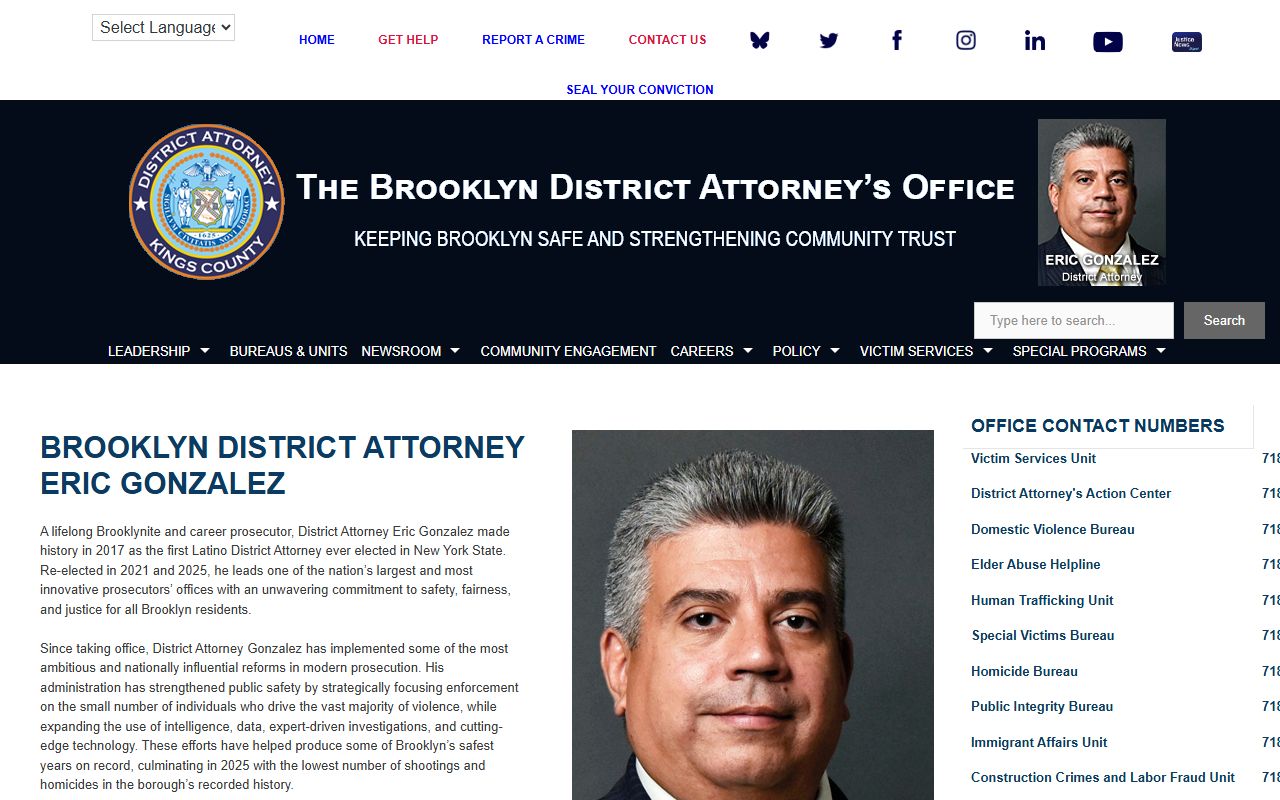
The prosecutor for Kings County is the Brooklyn District Attorney's Office. The current District Attorney is Eric Gonzalez. His official biography describes him as a lifelong Brooklynite and career prosecutor, and notes that he was first elected in 2017. The DA's office evaluates arrests, files or declines charges, appears in court, negotiates dispositions, and handles felony presentation where required.
The Brooklyn DA biography page identifies Eric Gonzalez as the elected prosecutor whose office handles Kings County criminal prosecutions.
That role explains why DOC charges and court charges can differ. DOC shows custody and basic case information. The DA's filing choices shape the court record. A formal filing may keep an initial charge, change the level, add a new count, or dismiss part of the case.
Bail Holds and Warrants
Bail in a Brooklyn criminal case is set by the court, not by the jail. DOC accepts bail in approved forms after a court order and processes release only when no other hold prevents it. DOC lists the Brooklyn court bail window at 120 Schermerhorn, Room 101C, 1st Floor, Brooklyn, NY 11201, open seven days a week from 8:30 a.m. to 1 a.m. NYC311 also says bail cannot be paid online until further notice.
| Release Issue | What It Means |
|---|---|
| Cash bail | Money paid in an accepted form after the court sets bail. |
| Bond | A secured release method that may involve a bond company. |
| Release on recognizance | The court releases the person without a money payment. |
| Remand | The court orders custody without bail. |
| Other hold | A warrant, parole hold, federal hold, ICE issue, or another case can block release. |
No official Kings County sheriff active-warrant roster was found in the research. Warrant fallback paths are court records, Criminal Court contact, attorney inquiry, NYPD/OpenRecords for police records, and the DOC lookup if the person is already in custody. NYC311 notes charge abbreviations such as CCW for Court Warrant and OJCW for Other Jurisdiction Warrant.
Charges Convictions and Sealing
A charge is an accusation. A conviction is a court result after a plea or verdict. Court records after a jail arrest should never be read as proof that the person was convicted unless the disposition says so. New York also restricts some records after favorable termination and protects victim-identifying material in certain cases.
| Point | Charge | Conviction |
|---|---|---|
| Stage | Filed accusation after arrest or indictment. | Final plea or verdict on a count. |
| Meaning | The government alleges an offense. | The court has entered guilt on that offense. |
| Can change? | Yes, it can be amended, reduced, added, or dismissed. | Changes usually require appeal, post-judgment relief, or later court action. |
New York commonly uses sealing rather than broad public expungement for these records. Criminal Procedure Law §160.50 seals official records after a criminal action ends in favor of the accused, unless an exception applies. Civil Rights Law §50-b protects records that identify sex-offense victims, including pictures and photographs held by public employees.
| Point | Sealed | Expunged |
|---|---|---|
| Public access | Restricted from ordinary public view. | Usually treated as removed or destroyed where a law allows it. |
| New York use | CPL §160.50 is the key favorable-termination route. | Do not assume expungement unless a specific statute applies. |
| Agency records | May be withheld from public request channels. | Depends on the exact legal remedy and record holder. |
FOIL separation: NYC OpenRecords is used for DOC jail records by selecting Department of Correction and for NYPD arrest records by selecting New York City Police Department. Court case records come from court clerks and court systems, while agency administrative records may be requested under Public Officers Law Article 6 and Public Officers Law §87.